BirdTunes identifies birds instantly from a photo or sound recording. Point your camera at any bird and it returns the species name, a photo match, and range information in seconds — and beak shape is one of the key features it reads. A hooked tip, a flat paddle, a needle-thin point: these are visible in almost any photo, even a blurry one taken at distance, and they carry a remarkable amount of information about which bird you're looking at.
You can use the same logic as a field skill, without needing your phone. Once you know the 8 main beak types and what each one is built for, an unfamiliar silhouette stops being a mystery. The beak alone narrows it down to a small number of families — usually before you've registered color, size, or song.
This guide covers all 8 beak types, with real examples of the birds that carry each one and what you can infer from each shape the moment you see it.
 The 8 main beak types and the food sources they're each built for. Source: Wikimedia Commons.
Why Beak Shape Is a Reliable Identification Shortcut
Every beak is a tool shaped by millions of years of evolutionary pressure to solve one problem: getting enough of a specific food source efficiently. A beak built for cracking sunflower seeds looks nothing like one built for spearing fish, because the two jobs require completely different mechanics. This is why beak shape correlates so strongly with diet, and why diet correlates so strongly with habitat: a fish-eating beak belongs to a bird that needs to be near water, a seed-cracking beak belongs to a bird that can thrive almost anywhere seeds are available.
This also means beak shape is one of the few identification features that holds steady across lighting conditions, distance, and even partial views. A backlit silhouette against the sky will often hide color and pattern completely, but the outline of the beak usually remains identifiable — and it's exactly what a photo identification tool like BirdTunes reads first.
The 8 Main Bird Beak Types
1. Seed-Cracking (Conical) Beaks
Short, thick, and cone-shaped, these beaks function like a built-in nutcracker. The wide base generates crushing force at the tip, letting the bird split open tough seed coats that would be impossible to penetrate with a thinner beak.
Look for it on: finches, sparrows, grosbeaks, and cardinals.
What it tells you: this bird is very likely visiting a feeder, foraging on the ground or in low shrubs, and eating primarily seeds and grain rather than insects.
 A male Northern Cardinal — the conical beak is the defining feature of seed-cracking finches and grosbeaks. Source: Wikimedia Commons.
2. Insectivorous (Thin, Pointed) Beaks
Narrow, sharp, and often slightly tweezer-like, these beaks are built for precision rather than power. They let the bird pick small insects off bark, leaves, or even snap them out of the air mid-flight.
Look for it on: warblers, flycatchers, wrens, and swallows.
What it tells you: this bird is an active, fast-moving forager that needs agility more than strength, and you'll usually see it darting and flicking through foliage rather than sitting still.
 The Willow Warbler's fine, needle-like beak is built for picking insects from leaves and bark. Source: Wikimedia Commons.
3. Hooked (Raptor) Beaks
Strong, curved, and sharply downturned at the tip, hooked beaks are built for tearing rather than cracking or picking. Paired with powerful talons, the hook lets the bird grip prey and pull meat apart in strips.
Look for it on: hawks, eagles, owls, and falcons.
What it tells you: this is a predator that hunts live prey or scavenges, and the beak is doing the job a knife and fork would do for a mammal.
 The Bald Eagle's sharply hooked beak is built for tearing flesh — the defining feature of all raptors. Source: Wikimedia Commons.
4. Chisel (Excavating) Beaks
Straight, strong, and squared off at the tip like a tiny chisel, these beaks are designed to absorb repeated high-force impact without breaking. Woodpeckers also have reinforced, shock-absorbing skull structures that work alongside the beak to survive constant hammering.
Look for it on: woodpeckers and sapsuckers.
What it tells you: this bird is drilling into wood, either to excavate insects from bark or to carve out a nest cavity, and you'll often hear it before you see it.
 The Red-bellied Woodpecker — the straight, robust chisel beak is built for impact-drilling into bark. Source: Wikimedia Commons.
5. Probing Beaks
Long, slender, and often slightly curved, probing beaks are built to reach into mud, sand, or shallow water without the bird needing to get its whole head wet. Many have sensitive tips that can detect prey by touch alone, without needing to see it.
Look for it on: sandpipers, ibises, and other shorebirds.
What it tells you: this bird is feeding in soft ground or shallow water, searching for worms, crustaceans, or other invertebrates hidden beneath the surface.
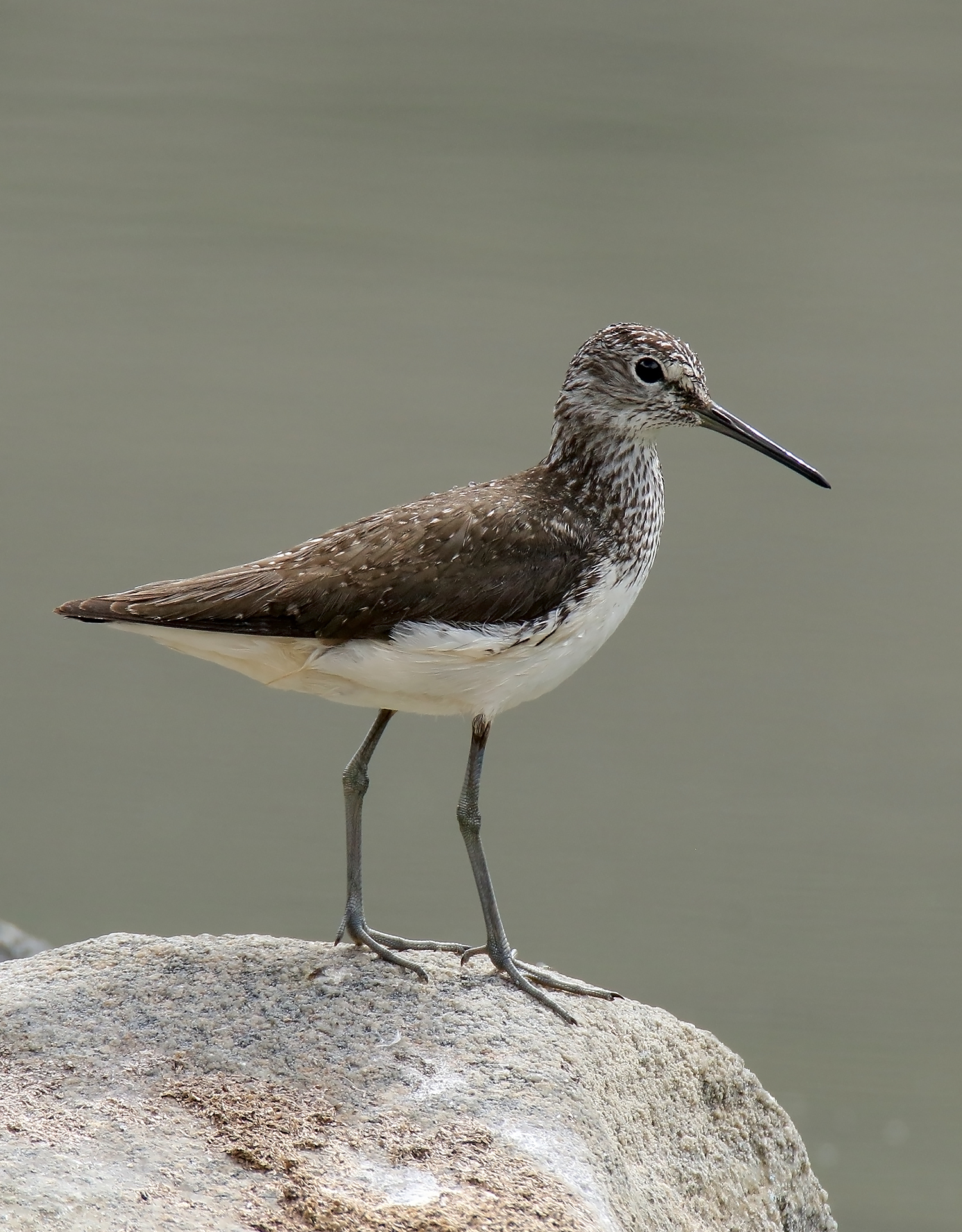 The Green Sandpiper's long, slender beak reaches into mud and sand to find invertebrates by touch. Source: Wikimedia Commons.
6. Spear (Fishing) Beaks
Long, straight, and dagger-like, these beaks are built for a single decisive strike rather than repeated pecking. Speed and precision matter more than crushing force, since the goal is to spear or grab a fast-moving fish before it escapes.
Look for it on: herons, kingfishers, and egrets.
What it tells you: this bird hunts fish or other aquatic prey, almost always near water, and is likely standing motionless or hovering just before a strike.
 The heron's beak is a precision spear — held still over the water until the moment of the strike. Source: Wikimedia Commons.
7. Filter-Feeding Beaks
Wide, flat, and often equipped with comb-like ridges along the edges, these beaks let a bird scoop up water and mud, then push the liquid back out while trapping small food particles inside. Flamingos take this further with a beak that's uniquely bent to filter-feed upside down.
Look for it on: ducks, swans, and flamingos.
What it tells you: this bird feeds by sifting through water or mud rather than catching individual prey items one at a time, and it's almost always found on or near a body of water.
 The Mallard's flat, wide bill has fine comb-like edges (lamellae) that filter food from water and mud. Source: Wikimedia Commons.
8. Nectar-Feeding Beaks
Extremely long, thin, and often curved to match the shape of specific flowers, these beaks are built to reach deep into a bloom while a long tongue does the actual nectar collection. The beak shape and the flower shape essentially co-evolved together.
Look for it on: hummingbirds, and to a lesser extent sunbirds and honeyeaters.
What it tells you: this bird needs consistent access to flowering plants and is likely hovering rather than perching while it feeds.
 The Ruby-throated Hummingbird's long, thin beak is co-evolved with the flowers it feeds from. Source: Wikimedia Commons.
Using Beak Shape Alongside Other Field Marks
Beak shape works best as your first filter, not your only one. A conical beak narrows your options to seed-eaters, but you'll still want to check size, color pattern, and habitat to get from "probably a finch" to a specific species. Think of beak type as the fastest way to eliminate the species it definitely isn't, before you spend time on the details that confirm exactly which one it is.
It's also worth remembering that beak shape reflects diet, not strict taxonomy. Unrelated species that evolved to eat similar foods can end up with strikingly similar beaks — a phenomenon called convergent evolution. This is part of what makes beak shape such a useful shortcut: it tells you about function first, which is often exactly the clue you need in the field.
Put This Guide Into Practice
Reading about beak shapes is one thing — matching them to the bird in front of you in real time is another. BirdTunes identifies birds instantly by photo or sound, drawing on a species database covering hundreds of species across 50+ countries, with 500+ identifications happening daily. The next time you spot an unfamiliar silhouette and want to confirm what that beak shape is telling you, point your camera at it and get the answer in seconds.